A Rajasthani wedding isn't one event — it's a sequence of functions, each with its own meaning, its own dress code, and its own set of rituals. Couples planning their first multi-day wedding often ask us the same question: what actually happens at each one? Here's the order, the meaning, and what to expect at every stage.
1. Tilak & Roka — The Formal Beginning
Before any of the larger functions, the two families formally acknowledge the match — the bride's family visits the groom's home (or vice versa) with gifts, sweets and blessings. It's intimate, usually just close family, and sets the date in motion.
2. Haldi — The Golden Ritual
A paste of turmeric, sandalwood and rosewater is applied to the bride and groom (often in separate ceremonies at each home) by family members, said to bless and purify before the wedding. It's playful, messy in the best way, and almost always shot in yellow and marigold.
3. Mehndi — Henna & Celebration
The bride's hands and feet are adorned with intricate henna, often taking several hours, while family and friends celebrate with music and dance around her. Many Rajasthani brides hide the groom's initials somewhere in the design for him to find later.
4. Sangeet — Music, Dance & Performances
Originally a women's-only ritual, the Sangeet has grown into one of the biggest functions of the wedding — both families choreograph performances, often with a live band or DJ, stage design and a full dance floor.
"We don't just plan the Sangeet stage — we help families choreograph, rehearse and pace the night so every performance lands the way it was meant to."
5. Baraat — The Groom's Procession
The groom arrives at the venue in a procession — traditionally on a horse or elephant, now often with a dhol band, fireworks and dancing guests — marking his formal arrival for the wedding ceremony. In Rajasthan, this can be one of the most photographed moments of the day.
6. Pheras — The Wedding Ceremony
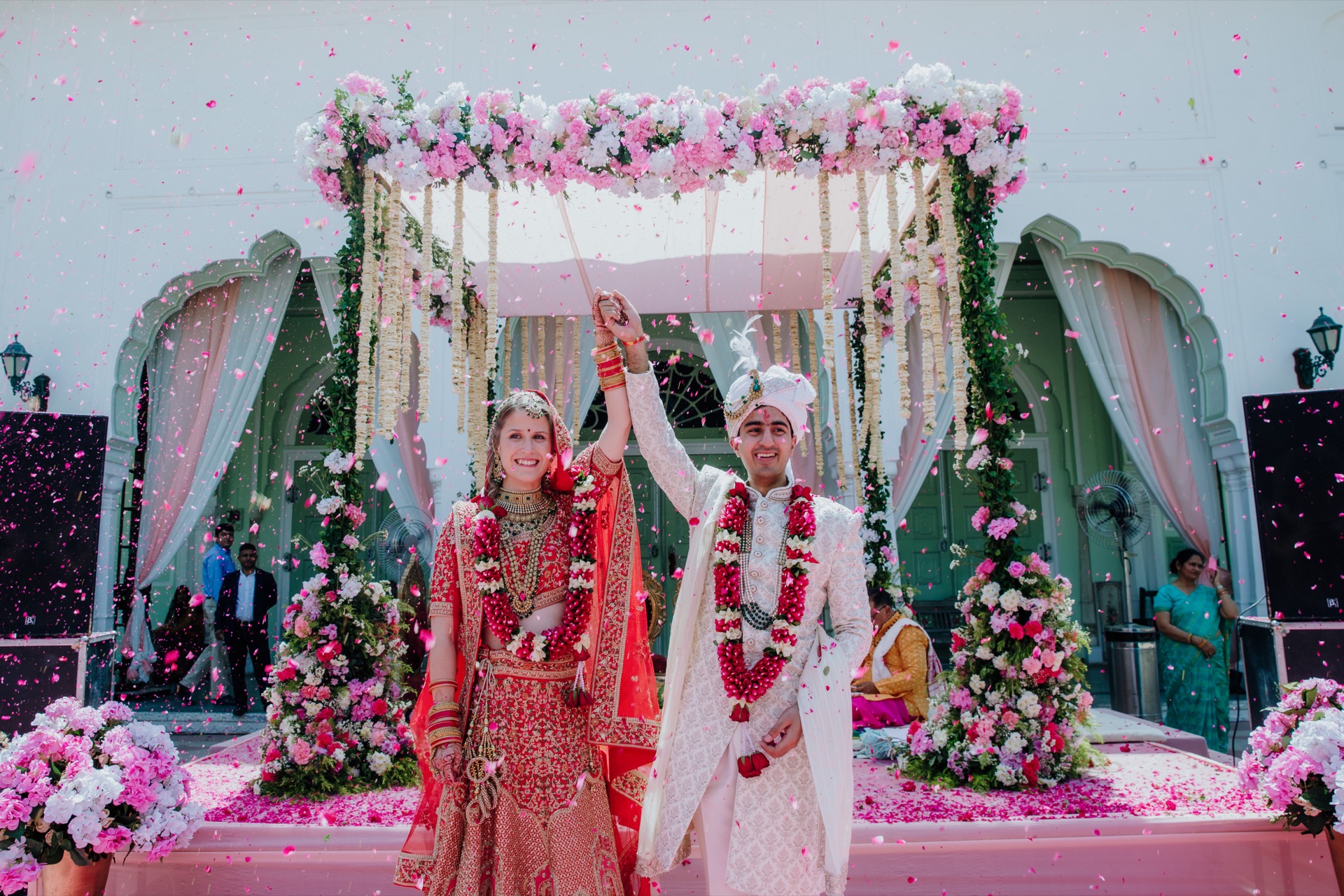
Under the mandap, the couple circles a sacred fire seven times, each round representing a vow — for nourishment, strength, prosperity, happiness, progeny, health and lifelong friendship. A pandit leads the ceremony, and this is the point at which the couple is considered legally and spiritually married.
What the Mandap Represents
The mandap — the decorated four-pillared canopy under which the Pheras take place — is treated as sacred space. In Rajasthan, mandaps are often built to echo the architecture of the venue itself, whether that's a palace courtyard or a desert dune.
7. Reception — The Grand Finale
A larger, often more formal gathering — sometimes the same evening, sometimes the following day — where the newly married couple is introduced publicly to extended family, friends and community as husband and wife.
8. Vidaai — The Bride's Farewell
One of the most emotional moments of any Rajasthani wedding — the bride formally leaves her family home to join her husband's family, often marked by tears, rice thrown over her shoulder for prosperity, and a final embrace with her parents.
Do You Need All of These Functions?
No — plenty of couples we work with choose a compact 2–3 day version: Mehndi and Sangeet combined into one evening, then wedding and reception the next day. Others want the full 5-day arc. Either way, the sequence and meaning behind each ritual stays the same; only the scale changes.